

Key Takeaways
- Outsourcing works when done deliberately. You get faster responses, 24/7 coverage, and lower unit costs only if you define outcomes, integrate tightly with your CRM, and calibrate scripts so agents sound like your brand.
- Know the real bill. Pricing may be per agent, per minute, or per resolution—plus onboarding, QA, language premiums, and peak surcharges. Choose the model that matches your volume pattern.
- Lead with AI, then layer humans. Use SuperU for tier-0 and tier-1 calls, keep a lean BPO or in-house team for edge cases, and prove impact with a two-week pilot before scaling.
What Is Call Center Outsourcing?
Call center outsourcing means hiring a third party to handle customer calls instead of staffing an internal team. Companies use it to reduce operating costs, provide round-the-clock coverage, manage seasonal spikes, and access trained agents faster than they could hire internally.
When support extends beyond calls to chat, email, and messaging, the same model is often called contact center outsourcing.
What Call Center Outsourcing Includes (and Where It Fits)
Outsourcing can cover:
- Inbound support: order status, returns, appointment booking, payments, tier-1 troubleshooting
- Outbound work: follow-ups, reminders, basic sales qualification
- Blended models: a mix of inbound and outbound across channels
Strong outsourcing programs integrate directly with your CRM, ticketing system, and analytics, so leadership retains visibility and control. Teams typically pursue outsourcing when they want faster response times, predictable costs, and expertise they can’t build quickly in-house.
Business Outcomes to Define Before You Outsource
Clear goals prevent paying for activity that doesn’t move the needle. Define targets such as:
- Lower cost per resolution while maintaining or improving CSAT
- Faster first response time and shorter queues
- Reliable after-hours and weekend coverage
- Elastic capacity for campaigns and peak seasons
- Clean compliance for payments, privacy, and industry rules
These outcomes become your vendor scorecard.
The Main Benefits (with Realistic Expectations)
Outsourced providers recruit and train agents, manage schedules, and supply telephony and QA tooling. You gain speed to launch, on-demand scale, and often a lower unit cost for common queries.
The tradeoff is control. To protect your brand, you need:
- Tight scripts
- A shared, well-maintained knowledge base
- Regular call calibrations
Many teams find outsourcing especially effective for late nights, holidays, and pilot programs, where permanent hires don’t make sense.
Hidden Risks—and How to Mitigate Them
- Brand dilution: Agents sound generic.
Fix: Weekly calibrations and a shared QA scorecard. - Data exposure: Vendors mirror your systems.
Fix: Least-privilege access, redacted recordings, login audits. - Knowledge loss: Vendor churn erodes expertise.
Fix: You own the knowledge base and version scripts internally. - Weak SLAs: Contracts measure activity, not outcomes.
Fix: Tie payment or bonuses to abandonment, FCR, and CSAT.
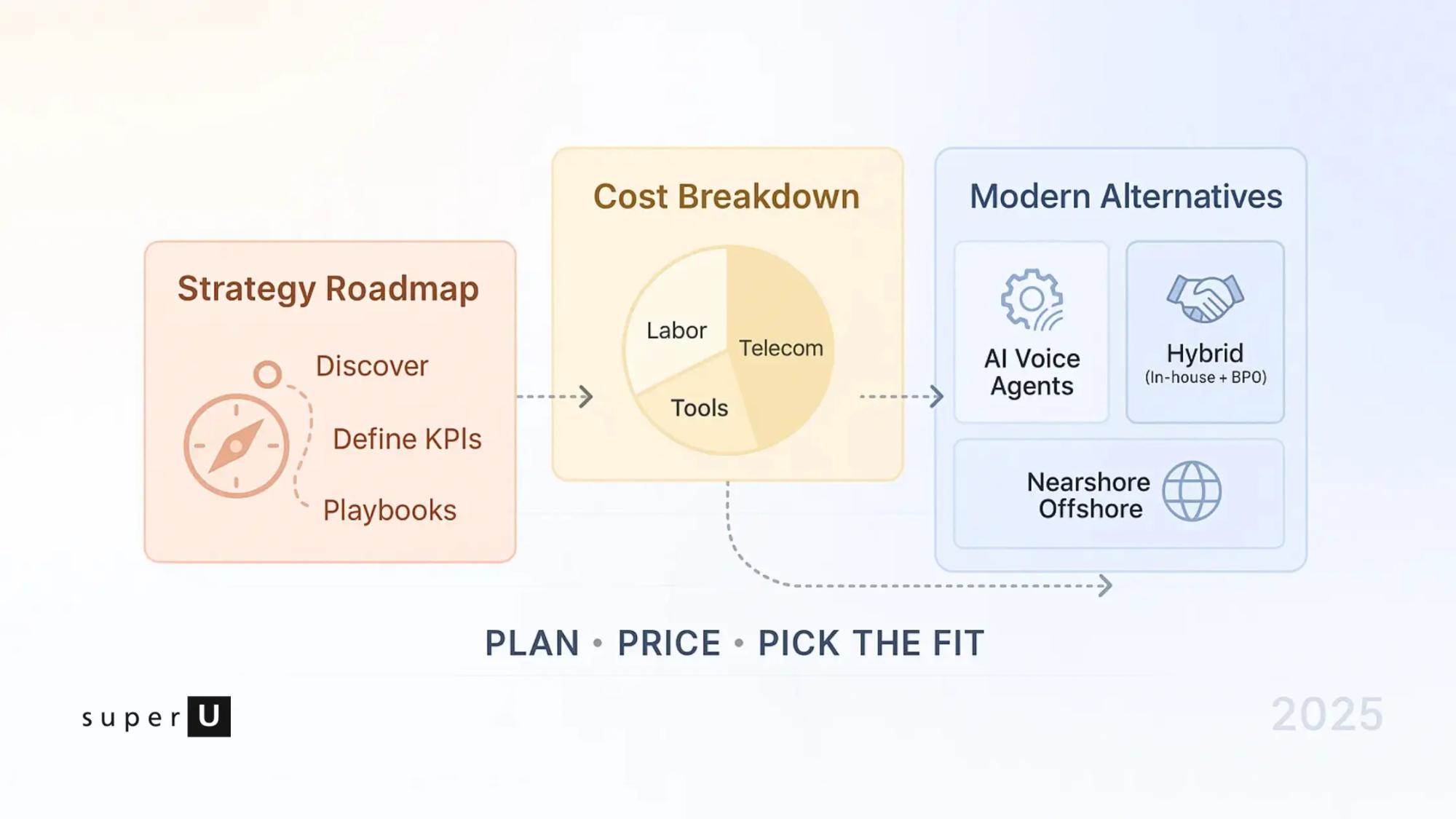
The Cost Breakdown You Can Plan For
Three common pricing models:
Per Agent (Monthly)
You reserve dedicated headcount.
Best for complex or regulated work. Less flexible during slow periods.
Per Minute
You pay for connected minutes only.
Great for variable volumes. Watch handle times and minimums.
Per Resolution / Per Case
You pay for outcomes.
Strong alignment, but requires clean intent definitions and data.
Additional costs to expect
- Onboarding and script design
- Knowledge base setup and integrations
- Ongoing QA and reporting
- Language premiums
- Peak or holiday surcharges
Always compare like for like when reviewing vendor totals.
Sample Cost Scenarios
- After-hours coverage: Per-minute pricing often wins—you avoid paying for idle time.
- Seasonal spikes: Shared agents lower off-peak cost, but SLAs must still protect response times.
- Complex workflows: Dedicated agents cost more but preserve accuracy and compliance in healthcare, finance, or field services.
Tooling and Integrations That Make or Break the Program
Your vendor must integrate cleanly with:
- CRM and ticketing
- Payments (with PCI-compliant redaction)
- Real-time dashboards for AHT, abandonment, and FCR
Look for searchable knowledge bases, agent assist tools, single sign-on, and role-based access controls. Without these, reporting drifts and audits slow down.
When AI Beats Traditional Outsourcing on Cost and Control
This is where SuperU fits first.
SuperU is an AI voice agent platform that handles common inbound and outbound intents, runs 24/7, integrates with major CRMs, and escalates to humans with full context. It deflects repetitive calls, books appointments, checks order status, and keeps your brand voice consistent.
Every interaction becomes structured data you can analyze in real time—reducing cost per resolution and queue times.
For many companies, the winning model is hybrid:
- AI handles tier-0 and tier-1
- A lean BPO or in-house team handles edge cases and VIPs
Vendor Shortlist (and What Each Is Best For)
- SuperU (AI voice agents): First-line automation, elastic scale, fast launch, full analytics
- Regional BPO partner: Local language nuance and cultural alignment
- Global BPO network: Multi-country coverage and complex compliance
This keeps flexibility as you learn which intents stabilize and can move to AI.
Example Hybrid Partnership Model
A practical path:
- Use SuperU as the front line for routine intents
- Partner with a BPO like Garage2Global for early operations, overflow, and complex cases
- Gradually shift volume from humans to AI as knowledge matures
This lowers unit costs without sacrificing care for edge cases.
Implementation Roadmap: Selection to Steady State
Week 0–1
Define intents, success metrics, and escalation rules. Pull the top 50 questions from tickets and calls.
Week 2–3
Build scripts and a living knowledge base. Integrate CRM, ticketing, and call recording. Configure security and redaction.
Week 4
Soft launch with a limited call share or after-hours window. Monitor dashboards daily. Run calibrations.
Week 5+
Ramp to full coverage. Hold weekly QA reviews and monthly business reviews. Expand AI coverage as patterns stabilize.
Metrics That Prove Success (and Keep Contracts Honest)
Track:
- First Contact Resolution (FCR)
- Average Handle Time (AHT)
- Queue time and abandonment
- QA pass rate
- CSAT
- Cost per resolution
Share dashboards with vendors so everyone works from the same numbers. Use root-cause analysis to refine scripts and knowledge continuously.
Common Mistakes to Avoid
- Outsourcing before documenting processes
- Ignoring after-hours demand
- Paying for multilingual coverage you don’t use
- Overcomplicating IVR paths without testing
Start with a focused pilot and expand based on data.
Frequently Asked Questions
1. Can AI really handle multilingual queries before escalation?
Yes—when intents are defined clearly and knowledge is strong. SuperU can answer routine queries in many languages and pass rich context to humans.
2. Can we start with after-hours only?
Yes. Many teams prove value on nights and weekends before expanding.
3. How do we exit a vendor safely?
Own scripts, knowledge, recordings, and integration keys. Run parallel coverage for one to two weeks.
4. How does this help during promotions or peak seasons?
AI and elastic staffing absorb spikes without hurting response times.
5. Where does outsourcing underperform?
When knowledge is tribal, systems are fragmented, or processes change weekly. Fix those first.
Conclusion
Call center outsourcing delivers speed, scale, and reliable coverage—when you define outcomes, own the knowledge base, and enforce strong integrations and security. AI belongs at the front of this stack.
Run a two-week pilot. Put SuperU in front to automate tier-0 and tier-1, and keep a small vendor or in-house team for escalations. That’s how you reduce cost without sacrificing customer trust.
Start for Free – Create Your First Voice Agent in Minutes
