

TL;DR
- Groq = hardware + ultra fast inference platform.
- Grok = xAI’s chatbot and model family.
- You use Groq to run models fast. You use Grok to get answers
What is Groq?
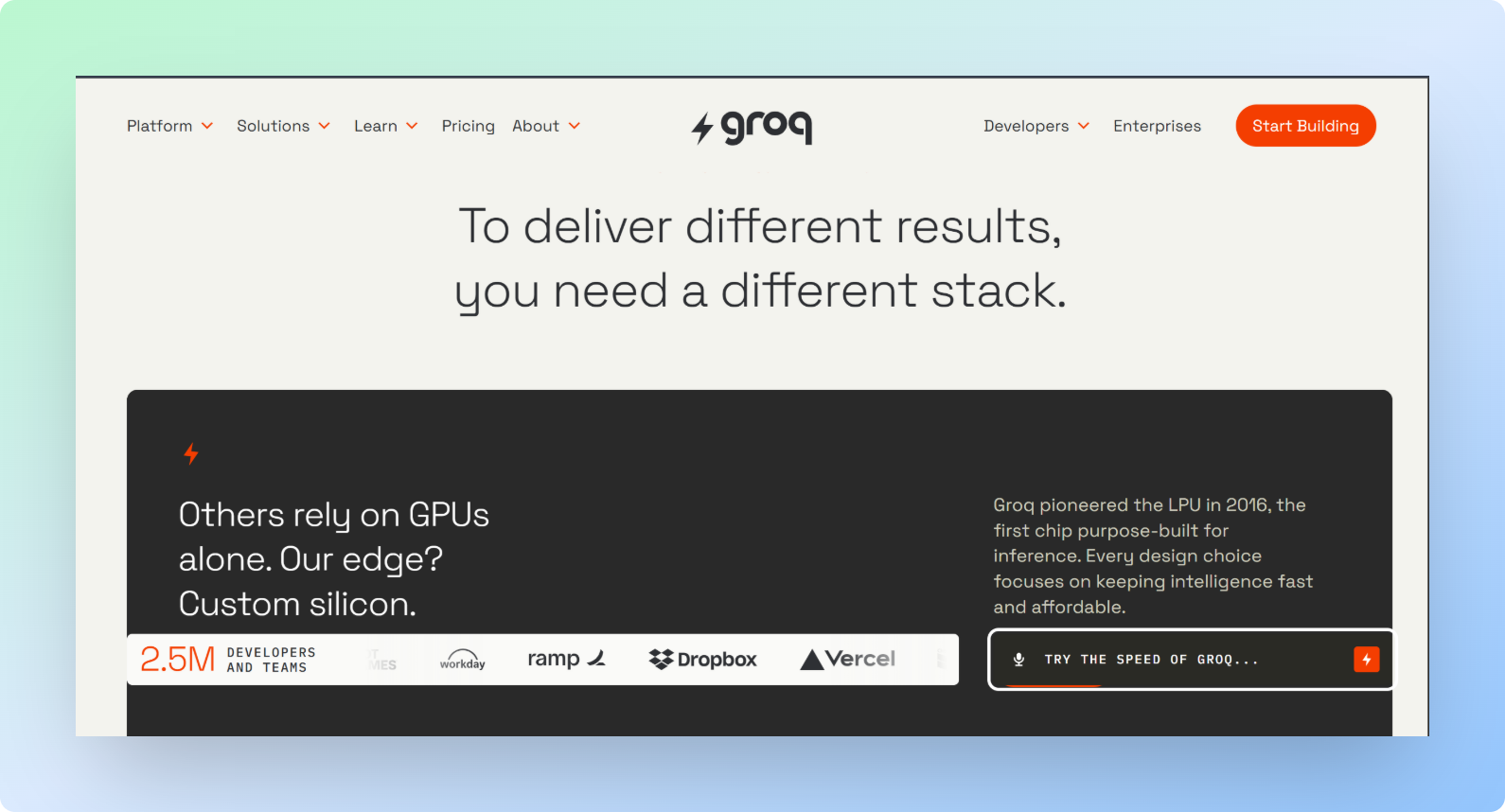
Groq builds Language Processing Units (LPUs) and a hosted inference platform designed for very high token throughput and predictable latency. In plain English: it’s the “engine” that generates words quickly and consistently when your product calls an LLM. Groq exposes an OpenAI compatible API, so most teams can swap it in with minimal code changes.
How Groq works
- Custom hardware (LPUs): chips purpose built for inference, not training.
- Hosted API: you send prompts to Groq’s endpoints; it streams back tokens fast.
- Open compatibility: OpenAI style routes like /chat/completions reduce migration time.
Groq publishes throughput numbers and partner news that show the speed story in the wild (e.g., work with Meta’s Llama API and public claims in the 500–600+ tokens/sec range on certain setups). Benchmarks vary by model and prompt, but the theme is consistent: low time to first token and high sustained tokens per second.
Where Groq fits best
- Real time voice: You need words back in under a heartbeat.
- High volume inference: Cost + speed matter when you scale to millions of turns.
- Deterministic UX: Consistent latency keeps conversations natural.
What is Grok?
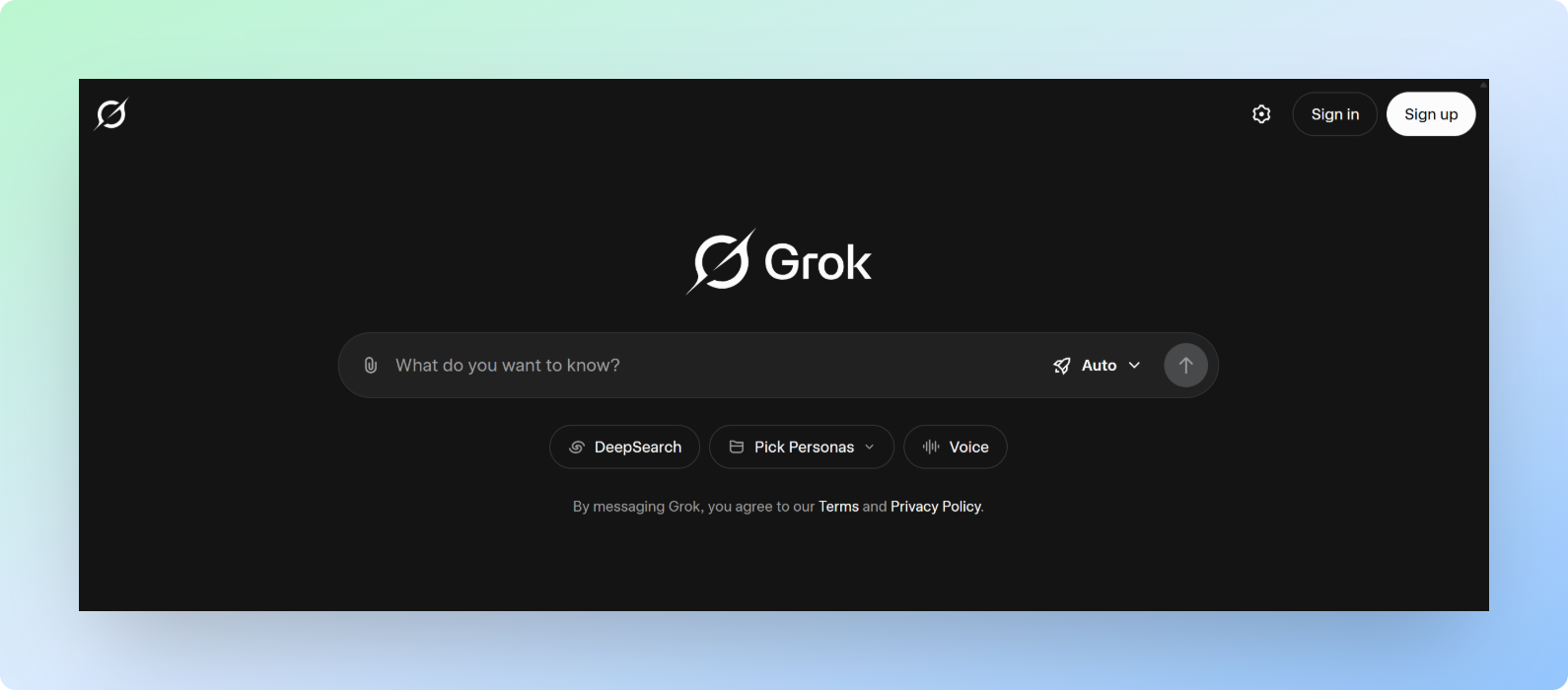
Grok is xAI’s assistant and model family (Grok 3, Grok 4, and “fast” variants). You can use Grok inside X (formerly Twitter) and through a developer API with listed context lengths and per token pricing. Think of Grok as the “brain” you ask for reasoning, code help, research, and more.
How Grok works
- Assistant + API: end user chat experiences, plus a developer API to call models.
- Model options: Grok 3 and Grok 4 families, with “fast” and coding tuned variants.
- Usage terms and pricing: xAI documents model tiers, context windows, and rates.
Grok keeps evolving API availability, model updates, and even distribution via Azure were all public milestones in 2025. Treat the model set as a moving target: powerful, but changing fast.
Where Grok fits best
- Assistant out of the box: Need a capable chatbot with reasoning and search.
- Developer workflows: Coding help, data extraction, research summaries.
- Product pilots: You want a named model with a clear API and SLA via major clouds.
Groq vs Grok: the real differences
Purpose
- Groq (with a “q”) = inference infrastructure. You bring the model(s); Groq’s platform runs them fast.
- Grok (with a “k”) = xAI model/assistant. You call the model; xAI hosts it.
What you actually get
- Groq: an API backed by LPUs, OpenAI compatible routes, model catalog (including open weight options), and speed focused docs.
- Grok: a named model family with documented pricing, context limits, and features.
Speed and latency
- Groq: markets high tokens/sec and low TTFB for real time apps; public posts and partner briefs show triple digit to 600+ tokens/sec scenarios (prompt dependent).
- Grok: you judge speed inside the xAI stack or via the API; focus is capability and reasoning, not infra level “tps” marketing.
Pricing and access
- Groq: you pay to run models on Groq’s platform; migration is often a few lines due to OpenAI compatible endpoints.
- Grok: xAI lists per million token pricing by model tier (e.g., Grok 3 inputs/outputs), with updates announced through docs and press.
Legal and branding confusion: why the names collide
People confuse them because the names look almost identical. Multiple explainers called out the trademark angle and the risk of market confusion: Groq (infrastructure company) vs Grok (xAI model/assistant). If you pitch or write docs, spell it out early. Your future readers will thank you.
Integration notes for builders (what we do at SuperU)
We built voice AI that feels human. That means we care about three things: latency, reliability, and control.
- Latency: For live calling, the listener notices a pause over ~300–400 ms.
- Reliability: We design for bursty traffic. Groq’s throughput focus helps when a campaign floods lines.
- Control: Some clients want open weight models, some want a specific “named” model like Grok 3. Our stack supports both patterns so teams can pick by use case: real time voice, research agent, or code helper.
Two extra realities to plan for:
- Policy and risk: Grok has faced content controversies and jurisdiction limits. If you’re embedding Grok outputs into production flows, set up guardrails and fallbacks.
- Model distribution is shifting: With Azure hosting Grok models, procurement and SLA paths are widening. That’s good for enterprises that standardize on Microsoft clouds.
Conclusion
Groq and Grok live at different layers. Groq is the speed layer hardware and an API for running models fast, predictably, and at scale. Grok is the model layer an assistant and developer API from xAI with clear pricing and fast iteration.
If you build real time voice or any app where delay kills UX, put Groq in your shortlist. If you need a ready, named model with reasoning power and enterprise paths, Grok is worth testing. Many teams will use both, routed by need.
FAQs
1. Is Groq a model?
No. Groq is hardware + an inference platform you call through an API. You run models on Groq
2. Is Grok open to developers?
Yes. xAI offers an API for Grok models, with published pricing and context windows.
3. Can I use Groq and Grok together?
Not directly. Grok is hosted by xAI (and now also available via Azure). Groq runs (mostly) open weight models and compatible APIs. In a product, you might use Groq for low latency voice turns and call Grok’s API for certain reasoning tasks. Route by use case.
4. Why do people cite tokens/sec for Groq but not Grok?
Because Groq sells infrastructure performance. xAI sells model capability; its updates lean more on features, availability, and pricing than infra benchmarks.
Launch real time voice with low latency. Book a SuperU demo today.
