


If your phone rings all day with random numbers, you are not alone. Robocalls are one of the most common complaints people file with U.S. regulators. So,
What are robocalls?
Robocalls are phone calls made with an autodialer that play a prerecorded or synthetic voice message when you pick up.
They usually fall into three buckets.
1. Real informational robocalls Examples: flight delay alerts, school closing messages, pharmacy refill reminders, appointment reminders from your doctor. These are often legal when you gave your number and consent.
2. Legit marketing robocalls These are sales calls from real companies that follow the rules. They should only call you if you agreed to get marketing calls or if you are not on the Do Not Call list.
3. Illegal scam robocalls These are the ones that pretend to be the IRS, a bank, a delivery service, tech support, or “your warranty department.” They often spoof the caller ID and try to push you into paying or sharing personal data.
Most of the truly annoying and dangerous robocalls you get fall in the third group.
Are robocalls legal?
This part is confusing for many people, so let’s keep it simple.
Robocalls that are usually allowed
Under U.S. law and Federal Communications Commission (FCC) rules, some automated calls are allowed, especially when they are informational and not pure sales. Examples include:
- School and weather emergencies
- Flight and travel updates
- Appointment reminders from your doctor or dentist
- Certain debt collection calls
- Messages from charities or political campaigns
Even then, they must follow rules on when they can call and how they identify themselves.
Robocalls that are usually illegal
The big red flag: sales robocalls that you did not agree to.
In general, it is illegal for a company to send you prerecorded or automated sales calls if:
- You did not give them clear permission
- Your number is on the National Do Not Call Registry and they have no existing relationship with you
- Scam robocalls that pretend to be the government, a bank, or a tech support team are flat-out illegal.
How do robocall scams work?
Scammers use cheap internet calling tools to make millions of calls at very low cost. They do not care if you are on the Do Not Call list. They only need a tiny percentage of people to believe them.
Two tricks show up again and again.
Caller ID spoofing
Caller ID spoofing means the scammer fakes the number that appears on your phone. It may:
- Look like your own area code
- Look like a local business
- Claim to be a government agency or your bank
The FCC warns that spoofing is very common in robocalls.
Pressure and fear
Scam robocalls use strong emotions. Common lines include:
- “Your account will be closed today if you do not act.”
- “You owe money and could face legal action.”
- “We detected suspicious activity. Press 1 to speak to an agent now.”
- They want you to react fast before you think.
What should you do when a robocall comes in?
Here is the first rule from the Federal Trade Commission (FTC): if you get an illegal robocall, hang up. Do not press any numbers.
Best reactions in the moment
- If you do not know the number, let it go to voicemail.
- If you pick up and hear a recording, hang up.
- Do not press a key to “speak to an agent” or “remove yourself from the list.”
- Do not share any personal details or payment information.
Pressing numbers or talking tells the caller that your number is active. That often leads to more spam calls.
If the call might be real, hang up and call back using a number from the company’s official website or your bank card, not from the call itself.
How to stop robocalls with simple habits
Technology helps a lot, but your own habits are the real first line of defense.
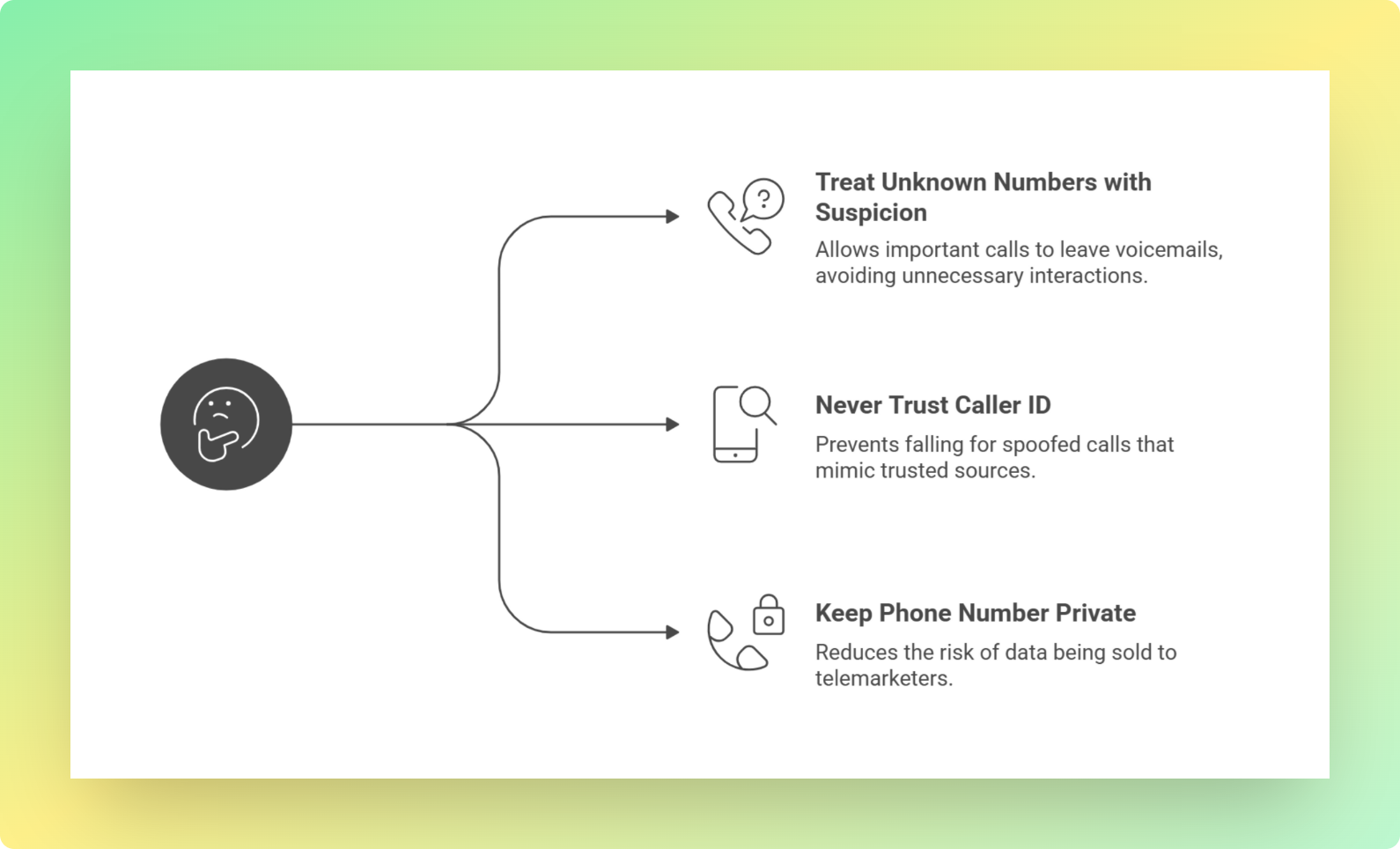
Do these three things every day:
1. Treat unknown numbers with suspicion Let them ring out. If it is important, they will usually leave a voicemail.
2. Never trust caller ID on its own Spoofing can make a scam call look like it is coming from your neighbor or your bank.
3. Keep your phone number private where you can Be careful with forms, contests, and “free offers” that ask for your phone number. Many sell your data to telemarketers.
These are boring rules, but they work.
How to stop robocalls with the National Do Not Call Registry
If you live in the United States and your number is for personal use, add it to the National Do Not Call Registry.
- It is free.
- You can register online at the official FTC site or by calling 1-888-382-1222 from the phone you want to register.
This will not stop all robocalls. It mainly reduces legitimate sales calls from companies that follow the law. Scammers will still try to call. But it is a good baseline step.
How to stop robocalls on your mobile phone
This is where most of your power sits. Modern mobile networks and devices give you several layers of protection.
Use your carrier’s spam protection
Major carriers now use caller ID authentication tools and spam detection at the network level to reduce spoofed and known bad numbers.
On Verizon, for example, you can:
- Enable spam alerts that label suspicious calls
- Use the Call Filter service to block or send suspected spam to voicemail
- Report numbers as spam so the system learns over time
Other carriers offer similar tools in their account settings or apps. Turn them on and choose the level of blocking you are comfortable with.
Block numbers on your phone
Both Android and iPhone let you block numbers directly from your call history. Typical steps look like this:
- Open the recent calls list
- Tap the number
- Choose “Block” and, if available, “Report spam”
If you keep getting spam from the same number, block it. It will not catch everything, but it reduces repeat offenders.
Consider a spam blocking app
Security companies and some phone makers offer apps that:
- Compare incoming calls against large databases of known spam numbers
- Show warnings like “Scam likely”
- Auto-block high-risk calls
AVG, for example, explains how dedicated apps can help label and block suspicious calls, but they also remind you that no app can stop every scam. You still need to use common sense.
Stick to well known, reputable apps from your phone’s official app store.
How to stop robocalls on your home phone
Many people still get the worst robocalls on their home landline or VoIP home phone.
Use your provider’s call blocking features
Home phone providers offer a mix of tools, such as:
- Call blocking lists where you add numbers you never want to hear from
- Anonymous Call Rejection to block callers who hide their number
- Caller ID and enhanced caller ID that can flag suspected spam
On Verizon home phone service, for example, you can turn on specific features in your account or through star codes from your handset.
Use a call blocking device
For traditional landlines, you can also buy a hardware call blocker. It sits between your wall jack and your phone. Many of these:
- Maintain a blacklist of spam numbers
- Let you approve or reject unknown callers
- Work even with older phones that lack smart features
Again, this is not magic, but it is another helpful layer.
How to report robocalls and help stop them
It feels like reporting does nothing, but regulators say the data helps them track patterns, enforce rules, and work with carriers to improve blocking.
You can:
- Report unwanted or illegal calls to the FTC at DoNotCall.gov
- File complaints about illegal robocalls and spoofing with the FCC
- Use your carrier’s app to mark numbers as spam
When you report, include:
- The number that received the call
- The number that appeared on your caller ID
- Any number they told you to call back
- A brief description of what the call said
The more details they have, the easier it is to act.
How to protect older family members and kids
Scammers often target older adults. They may be more trusting, may live alone, or may feel polite pressure to stay on the line.
To protect them, you can:
- Set up call blocking and spam filtering on their phones
- Add trusted contacts so real calls get through more easily
- Explain that no real government agency will call to demand payment by gift card or wire transfer
For kids and teens, keep it simple:
- Tell them not to pick up unknown numbers
- Ask them to show you any strange voicemail or text
- Make clear they should never share codes, passwords, or card details over the phone
Quick Ways: To stop robocalls today
If you only do a few things after reading this, make them these:
1. Register your personal number on the National Do Not Call Registry.
2. Turn on your carrier’s spam and robocall protection.
3. Block and report bad numbers on your phone.
4. Never press buttons or share details on a robocall. Just hang up.
Repeat these over time and you will see a drop in useless calls.
If you run a business, tidy up your phone experience

Here is where my superu AI hat comes on.
Phone lines are not just annoying for businesses. They are expensive. A typical company gets a mix of:
- Real customer calls that matter
- Internal calls between staff
- Spam, robocalls, and wrong numbers
You cannot fully control who dials your number, but you can control what happens when they connect.
With a voice platform like superu AI, you can:
- Put an AI receptionist in front of your business number
- Let the agent greet every caller, 24/7
- Route genuine customers to the right place
- Log spam and failed calls so your team does not waste time
You still use the same carrier tools we covered above to block obvious robocalls. On top of that, your AI agent helps make sure that real people get fast answers and that your team only steps in when they are truly needed.
That is the core idea: cut noise, protect customers, and make every real call count.
Conclusion
You cannot stop every robocall. Scammers use cheap tech, fake caller IDs, and huge calling lists. But you are not powerless.
When you mix good habits with the tools that already exist, you can cut a big chunk of the problem. The National Do Not Call Registry reduces legit sales calls. Carrier spam filters and call blocking apps catch many bad calls before your phone even rings. Device-level blocking and careful reporting help push repeat offenders out of your way.
Most of all, remember this. A stranger who calls you has to earn your trust. Not the other way around. If something feels off, hang up, verify through an official channel, and protect yourself and your family first.
Protect your calls and customers today. Map one clear phone strategy now.
