

Why RingCentral Works for Many but Growing Teams Still Leave
RingCentral combines business calling, video meetings, and team messaging into one platform. It scales globally, integrates with major CRMs, and positions itself as a long-term, future-proof communications solution. For many new adopters, RingCentral feels like a safe and established choice.
However, as teams grow and calling volumes increase, cracks begin to show. Leaders often realize that what works at ten users does not always scale cleanly to fifty or more.
Four Issues That Push Teams to Look Elsewhere
Costs Grow Faster Than Teams Expect
RingCentral’s core plans typically start around $30 to $45 per user per month. As teams add toll-free minutes, advanced analytics, webinar licenses, or compliance features, monthly bills rise quickly. What begins as predictable pricing often turns into a layered cost structure that is hard to forecast.
SMS Limits Constrain Outreach
Lower-tier plans impose strict SMS caps, sometimes as low as twenty-five messages per month. This forces sales and support teams to ration customer updates, appointment reminders, and follow-ups, even when texting is a preferred channel.
Admin Experience Can Be Overwhelming
Administrators frequently report a steep learning curve. Common complaints include confusing call-transfer flows, buried settings, and too many configuration layers for simple changes. For lean teams, everyday administration becomes a time sink.
Outages Highlight Risk
Even large platforms experience downtime. A major North American outage on 22 January 2025 disrupted voice service for thousands of customers and underscored the operational risk of relying on a single, tightly bundled system during peak hours.
SuperU vs RingCentral: From IVR Menus to AI Conversations
SuperU approaches business calling from a different angle. Instead of layering AI on top of traditional IVR trees, SuperU replaces IVR entirely with AI voice agents that understand natural language.
Callers speak normally instead of pressing keys. Requests are understood, routed correctly, and resolved faster. Managers receive clean transcripts and structured summaries rather than raw recordings, making coaching and compliance easier.
Businesses switching from legacy IVR systems to SuperU consistently report shorter queues, fewer misrouted calls, and improved caller satisfaction within the first week.
Seven RingCentral Alternatives You Can Trust
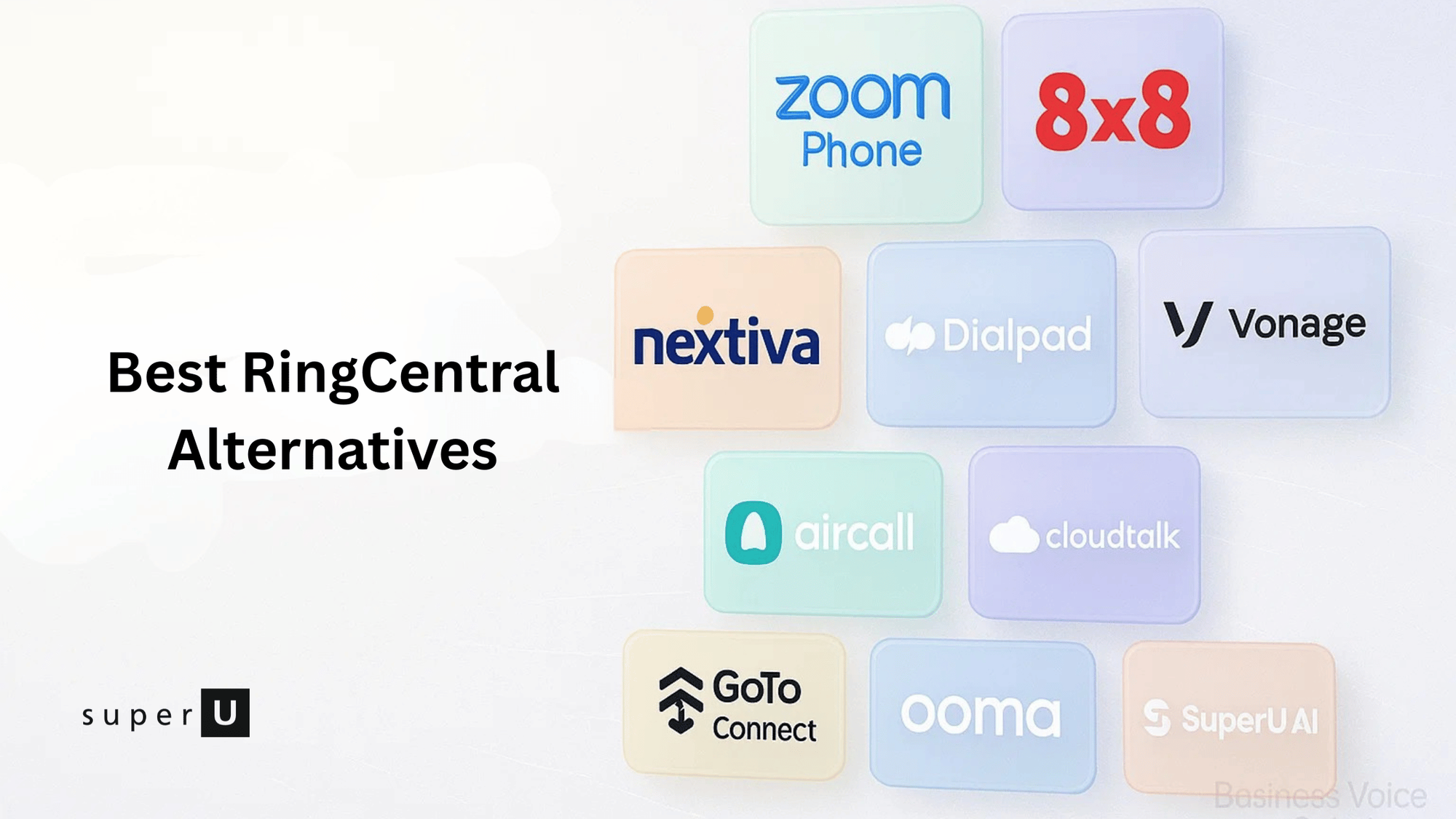
Businesses seeking alternatives to RingCentral often prioritize lower costs, simpler administration, better texting, or more responsive support. Below are seven established platforms, each suited to a different use case.
Nextiva: Best for Unified Communications and Support
Nextiva offers a unified communications platform that combines calling, video, team chat, and customer experience management. It supports both inbound and outbound contact center workflows and is widely praised for reliability.
A key differentiator is customer support. Many users highlight fast response times and knowledgeable agents, which reduces downtime and frustration.
Nextiva provides omnichannel interaction management, 24/7 support, and a 99.999% uptime guarantee backed by multiple redundant data centers. It integrates with major CRMs such as Salesforce, HubSpot, and Microsoft Dynamics.
Pricing starts at $20 per user for digital-only channels. Voice-enabled plans begin at $30, with higher tiers unlocking call center tools, chatbots, and advanced routing. It is best suited for businesses that value reliability and hands-on support.
Vonage: Best for API Customization
Vonage stands out for its extensive APIs and customization options. Teams can tailor calling workflows and deeply integrate communications into internal systems without heavy setup overhead.
Vonage offers unlimited domestic calling, number porting, and a centralized admin portal. Pricing starts around $13.99 per line, with higher tiers unlocking video meetings, team messaging, and advanced call features.
It is ideal for companies with technical resources that want flexibility, though some advanced features are locked behind higher plans and support experiences can vary.
Ooma: Best Budget-Friendly Option
Ooma targets small businesses looking for affordability and simplicity. It includes essentials like call routing, hot desking, and basic CRM integrations without overwhelming users.
Plans range from roughly $19.95 to $29.95 per user, with higher tiers adding call recording, texting, and call center features. Ooma is easy to deploy and transparent on pricing, though it lacks the depth and extensibility of larger platforms.
It works best for small teams that need reliable calling without complex workflows.
Aircall: Best for Call Center Analytics
Aircall is built specifically for sales and support teams. It excels in analytics, CRM integrations, and call monitoring.
Features include power dialers, voicemail drops, mandatory call tagging, live monitoring, and AI-powered conversation intelligence. Pricing starts around $30 per user with a minimum seat requirement.
Aircall is ideal for revenue teams that rely heavily on data-driven call analysis, though it is less suited for teams seeking a full unified communications suite.
Dialpad: Best for AI-Powered Insights
Dialpad emphasizes AI-first calling. It offers real-time transcription, sentiment analysis, and smart call summaries inside a modern, easy-to-use interface.
Plans start at $15 per user, with higher tiers unlocking CRM integrations, APIs, and priority support. Dialpad is well-suited for teams that value live insights and AI assistance, though some advanced features require upgrades or usage-based add-ons.
Grasshopper: Best for Solopreneurs
Grasshopper is designed for solo founders and micro-businesses. It provides virtual numbers, call forwarding, and voicemail without the complexity of full VoIP systems.
Pricing is based on numbers rather than users, starting around $14 per month. Grasshopper lacks advanced features like video or team chat, but it is reliable, simple, and easy to manage for very small teams.
Zoom Phone: Best for Zoom-Centric Teams
Zoom Phone extends Zoom’s video platform into business calling. Users can move seamlessly between calls and meetings within the same app.
Plans start around $10 per user for metered calling and scale up to global plans with compliance features. Zoom Phone works best for organizations already invested in Zoom Meetings, though it lacks some advanced call-center capabilities.
Five-Step Migration Checklist
Export all users, call logs, greetings, and recordings from RingCentral and store them securely.
Collect recent invoices and unlock all phone numbers to avoid porting delays.
Activate free trials for at least two alternatives and test call quality during real business hours.
Rebuild auto-attendants, queues, and after-hours rules in the new system and validate each path internally.
Schedule final number porting during low-volume hours and train staff the following morning to minimize disruption.
Frequently Asked Questions
Is RingCentral Free
RingCentral offers a limited trial period but does not provide a permanent free plan.
Which Alternatives Offer Transparent Pricing
Zoom Phone, Dialpad, and Ooma Office are often cited for clear entry-level pricing.
Can I Keep My Existing Numbers
Yes. Number portability is regulated, and all listed providers support toll-free and local number porting.
How Long Does Migration Take
Small teams with fewer than twenty numbers typically complete migration within two weeks when documentation is ready.
Can I Move Call Recordings
Yes. Download recordings from RingCentral first, then upload them to the new system’s archive or voicemail modules.
Final Takeaway
RingCentral remains a strong platform, but its pricing structure, SMS limits, administrative complexity, and occasional outages push many growing teams to reassess.
Some businesses choose simpler VoIP providers. Others move toward AI-first calling. Teams that replace IVR-heavy workflows with SuperU’s AI voice agents reduce queues, improve resolution rates, and gain structured call intelligence without increasing headcount.
If your phone system is becoming harder to manage than the calls themselves, it may be time to rethink the stack.
Test SuperU’s AI voice agent free for thirty days and see routine calls resolve themselves automatically.
Start for Free – Create Your First Voice Agent in Minutes
