

TL;DR
Sentiment analysis turns messy text and speech into clear positive, negative, or neutral signals.
Teams use it to track brand health, improve customer service, and make better product and marketing decisions.
superU adds sentiment analysis to voice calls, so you do not just automate calls, you understand how customers feel on every interaction.
What Is Sentiment Analysis?
At a basic level, sentiment analysis is the process of using software to determine whether a piece of text or speech expresses a positive, negative, or neutral feeling.
IBM describes sentiment analysis as analyzing large volumes of text to understand overall emotional tone. The goal is not just to read what customers say, but to interpret how they feel when they say it.
You can apply sentiment analysis to many kinds of customer data, including social media posts and comments, product reviews on marketplaces or app stores, support tickets and chat transcripts, emails, survey responses, and open-ended feedback fields.
In short, sentiment analysis tells you not only what people are saying, but the emotional context behind those words.
How Does Sentiment Analysis Actually Work?
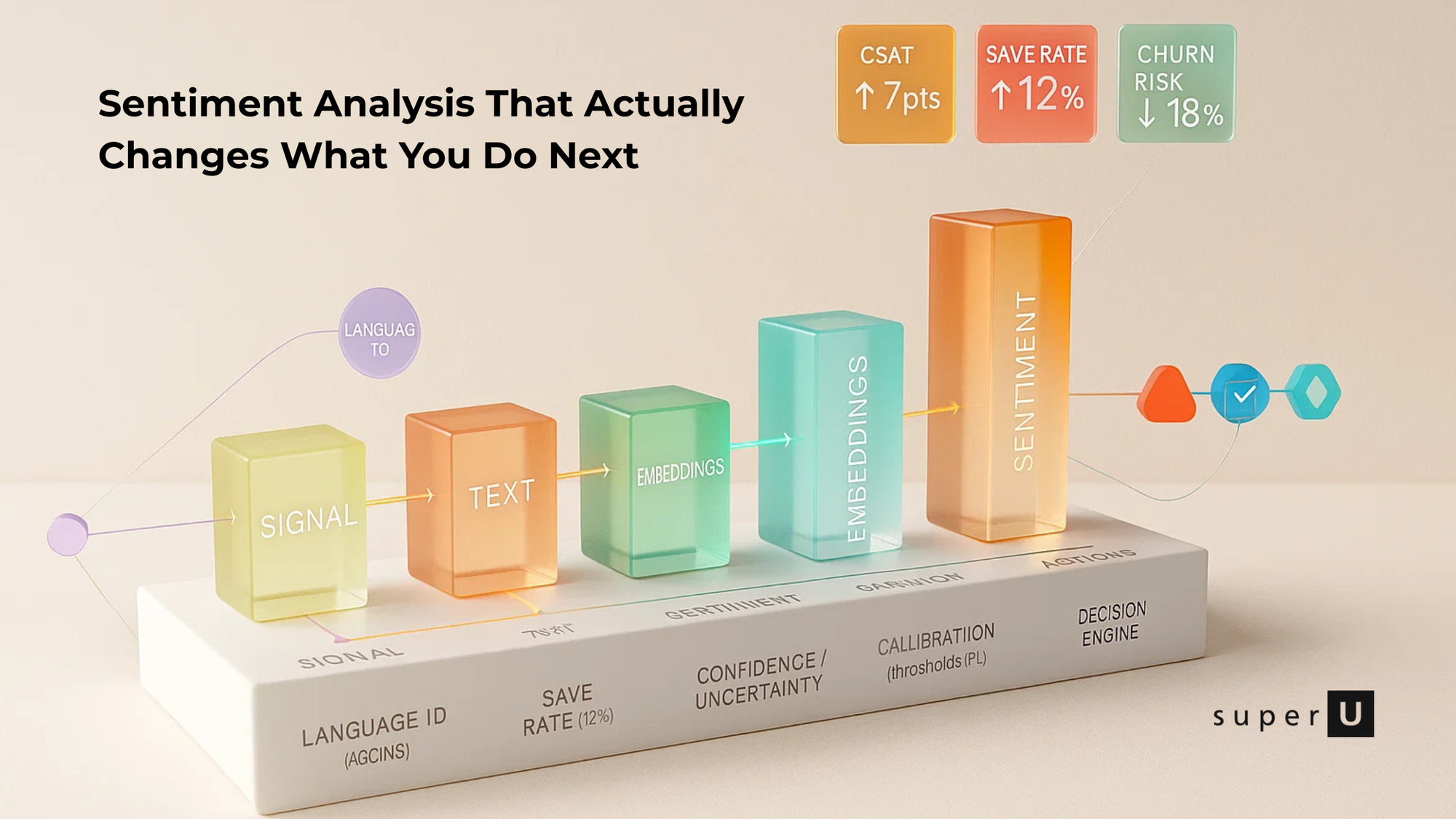
You do not need to be a data scientist to understand the basics. Most modern sentiment analysis systems follow a similar pipeline.
Collect and Clean the Data
First, tools collect text or transcripts from sources such as social platforms, review sites, helpdesks, CRMs, or call recordings.
The system then cleans and prepares the data by breaking sentences into tokens, normalizing spelling, handling slang or emojis, and removing common filler words that do not carry sentiment.
Use AI Models to Detect Sentiment
Under the hood, sentiment analysis relies on natural language processing and machine learning.
There are three common approaches.
Rule-based systems use dictionaries of positive and negative words with handcrafted rules.
Machine learning models learn patterns from large labeled datasets.
Hybrid approaches combine rules and machine learning to improve accuracy and nuance, which vendors like Lexalytics recommend.
Modern tools go beyond simple labels. They often score sentiment intensity, understand context instead of isolated words, and handle informal language, emojis, and domain-specific phrasing.
Turn Scores Into Insights and Actions
Once individual messages are scored, platforms aggregate results into dashboards and alerts.
You can track sentiment trends over time, compare sentiment across channels like social media, reviews, and support tickets, and break sentiment down by topic such as pricing, delivery, or product quality.
At this stage, sentiment analysis stops being about reading individual comments and becomes a way to monitor the emotional “pulse” of your customers.
Why Sentiment Analysis Matters for Your Business
You already track metrics like clicks, impressions, and conversion rates. Sentiment analysis adds an emotional layer to those numbers.
Protect and Grow Your Brand
Social sentiment analysis shows how people feel about your brand or campaigns in real time.
If a product launch or pricing change triggers negative reactions, you can spot the drop in sentiment early and respond with fixes, clearer messaging, or FAQs before it turns into a public issue.
Improve Customer Experience
In customer support, sentiment helps teams prioritize and route conversations.
You can identify frustrated customers faster, send complex issues to senior agents, and understand which topics consistently create negative feelings.
For example, AWS allows developers to apply sentiment analysis to each user utterance and adjust conversation flow, including escalating to a human agent when sentiment turns negative.
Guide Product and Marketing Decisions
Sprout Social explains that sentiment analysis on reviews and social data reveals how customers react to features, pricing, and messaging.
This lets you identify features people love, uncover friction points like shipping delays or confusing onboarding, and measure how campaigns shift sentiment over time.
Instead of guessing what customers want, you adjust roadmaps based on clear emotional signals.
Track Brand Health Over Time
Social listening platforms like Hootsuite and Brandwatch encourage teams to treat sentiment as a long-term KPI.
You measure not just how often your brand is mentioned, but the balance of positive versus negative mentions. That balance becomes a simple, powerful indicator leadership can understand at a glance.
Top Sentiment Analysis Tools
While superU focuses on voice sentiment, most teams also need tools for social media, reviews, and text data. Commonly used platforms include social listening and analytics tools, customer feedback analysis platforms, and developer-focused NLP APIs.
The right choice depends on where your conversations happen and how much customization you need.
How superU Uses Sentiment Analysis for Call Automation
superU focuses on voice, where emotions are often strongest. Customers call to place orders, ask questions, complain, or express appreciation.
superU’s AI voice agents handle these calls at scale and apply sentiment analysis to call transcripts and live utterances. Each call is tagged with emotional signals that indicate whether the customer sounded satisfied, confused, or frustrated.
Negative sentiment can trigger fallbacks to human agents, flag risky interactions, or surface accounts at risk of churn. Over time, teams can analyze sentiment by time of day, script version, store location, or campaign.
Instead of only seeing how many calls were handled, you see how customers felt during those calls and where experience improvements matter most.
Real-World Examples of Sentiment Analysis in Action
Tracking Campaign Reactions in Real Time
When you launch a new campaign or pricing page, sentiment analysis lets you monitor early reactions.
You can see whether confusion or frustration is emerging, adjust messaging quickly, and prevent small issues from becoming widespread backlash.
Improving Customer Support With Sentiment
A common workflow involves analyzing support tickets or post-call surveys by issue type, identifying the main drivers of negative sentiment, fixing root causes, and measuring sentiment again after changes.
This ties operational improvements directly to emotional impact, not just ticket volume.
Routing Calls Based on Mood
AWS documentation describes using sentiment analysis on each user utterance to decide when to escalate to a human.
In practice, an AI agent handles the initial conversation, but if sentiment drops sharply, the call is transferred to a live agent. Managers then review these calls to improve scripts and training.
superU follows the same principle. Automation handles scale, but sentiment determines when a human should step in.
Mining Reviews for Product Decisions
By grouping reviews by feature and analyzing sentiment for each group, teams can uncover small fixes that drive disproportionately strong emotional reactions.
This is especially valuable when review volumes are too large to read manually.
Best Practices When You Start Using Sentiment Analysis
Focus on Coverage Before Scores
A clean dashboard is meaningless if it only covers a fraction of conversations. Pull data from all major channels, not just the loudest ones.
Treat Sentiment as Directional
Sentiment models are not perfect, especially with sarcasm or mixed emotions. Trust trends more than individual labels and review samples regularly.
Combine AI With Human Review
Sentiment highlights where to look, not what to decide. Teams should inspect real conversations around spikes and drops before acting.
Tie Sentiment to Business Metrics
Sentiment becomes powerful when linked to churn, retention, repeat purchases, CSAT, and campaign performance.
For example, you might see that improving onboarding increases both positive sentiment and conversion rates, making sentiment analysis directly relevant to revenue.
How Sentiment Analysis and Call Automation Fit Together
Most sentiment discussions focus on social media and reviews, but phone calls still capture some of the most emotional customer moments.
When you combine call automation with sentiment analysis, you scale without losing emotional context, detect bad experiences early, and give leaders visibility into which scripts or campaigns create happy or unhappy customers.
At superU, this combination turns the call center from a black box into a measurable system that improves week by week.
Conclusion
Sentiment analysis converts unstructured customer language into clear emotional signals. It shows whether people feel positive, negative, or neutral about your products, service, and brand.
Vendors like IBM, AWS, Brandwatch, Hootsuite, Lexalytics, MonkeyLearn, and Sprout Social have demonstrated its value across text and social data.
When sentiment analysis is applied to voice calls, its impact grows even stronger. Calls often contain the most honest emotional signals. Automating those calls with AI, understanding the mood on each interaction, and linking that mood to outcomes creates a powerful feedback loop.
This is the loop superU focuses on. Not just whether someone called, but how they felt and what should improve next.
Start using sentiment aware call automation to reduce churn and grow happier customers.
